
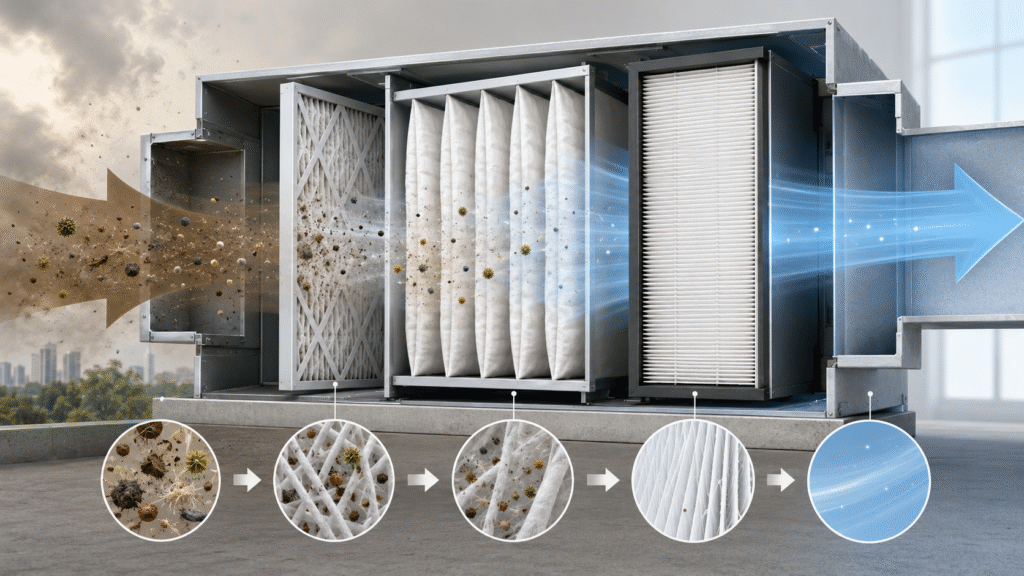
Air quality has become one of the most important factors affecting human health, building performance, and industrial operations. As HVAC systems become more widely used in hospitals, factories, offices, data centers, and food-processing facilities, air filters increasingly serve as the first line of defense against dust, airborne particles, and other contaminants.
The environmental impact of air filters is not limited to removing pollutants. Filters can also influence energy consumption, HVAC equipment life, maintenance requirements, and the amount of waste generated through replacement.
Choosing the correct filter is therefore both an environmental and an operational decision.
Excellect Filter Factory offers a comprehensive range of air-filtration solutions, from preliminary filters to ultra-high-efficiency filters, covering efficiency classes from G2 to U15. These products are designed for commercial buildings, hospitals, data centers, industrial facilities, food-processing plants, and other applications. The company’s catalog also places sustainability and environmental comfort at the center of its filtration activities.
1. Reducing Dust and Airborne Particles Indoors
Dust and airborne particles enter buildings through outdoor air, doors, windows, ventilation systems, and everyday human activity. Some industrial and manufacturing processes also generate particles inside the facility.
Without proper filtration, these contaminants can circulate throughout offices, hospitals, factories, and public buildings.
Air filters capture particles before conditioned air is distributed throughout the building. Their performance depends on several factors, including:
- Filter-media type
- Filtration efficiency
- Media surface area
- Air velocity
- Pressure drop
- Filter installation and sealing
Pre-filters are generally used to capture larger particles, while fine filters and high-efficiency filters remove smaller contaminants.
Using several filtration stages can improve overall air quality while protecting final filters from excessive dust loading and extending their service life.
The Excellect catalog includes several filtration categories, such as:
- Metallic filters
- Aluminum filters
- Synthetic-fiber filters
- Pleated filters
- Bag filters
- Mini-pleat filters
- V-cell filters
- HEPA filters
This range allows filtration systems to be selected according to the contamination level and operational requirements of each facility.
2. Protecting Human Health and Improving the Indoor Environment
The environment does not only refer to outdoor air. The quality of the indoor environment in which people spend much of their time has a direct effect on their comfort, well-being, and ability to work.
Appropriate filtration helps reduce the concentration of airborne dust and particles, contributing to better indoor-air quality.
This is particularly important in facilities such as:
- Hospitals and healthcare buildings
- Operating rooms
- Pharmaceutical facilities
- Food-processing plants
- Laboratories
- Cleanrooms
- Schools and universities
- Offices and commercial buildings
- Data centers
- Industrial facilities
The Excellect product catalog includes filters developed for medical, pharmaceutical, food-processing, and industrial applications. It also describes synthetic filtration media that are non-toxic and non-allergenic, as well as treated media designed to inhibit the growth of microorganisms.
Air filters, however, should not be viewed as a complete solution by themselves. They must operate as part of a properly designed ventilation system that provides sufficient fresh air and controls temperature, humidity, and pressure according to the facility’s requirements.
3. Reducing Energy Consumption Through Lower Pressure Drop
Air must pass through the filter before being supplied to occupied areas. The greater the resistance against airflow, the more energy the fan requires to maintain the desired air volume.
This airflow resistance is known as pressure drop.
Pressure drop is one of the most important factors when evaluating the environmental performance of an air filter.
A high-efficiency filter may provide excellent particle removal, but it can increase energy consumption when:
- Its design is unsuitable for the system
- Its surface area is too small
- Air velocity is too high
- It remains in service after becoming excessively loaded with dust
- The system fan is not selected for the resulting resistance
Filters with a larger media surface allow air to move through the material at a lower velocity. This can help reduce resistance and fan-energy consumption.
The Excellect catalog explains that the multiple V-bank arrangement used in V-CELL filters significantly increases the amount of filter media compared with conventional rigid or cartridge filters. Depending on the design, this arrangement can provide between 40% and 300% more surface area, contributing to lower pressure drop, longer service life, reduced operating costs, and greater energy savings.
The catalog also states that the radial wedge pleat design used in Excellect pleated filters helps minimize end losses, reduce resistance, and save energy.
4. Protecting HVAC Equipment and Reducing Resource Waste
Filters do not only protect building occupants. They also protect:
- Cooling and heating coils
- Fans
- Air-handling units
- Ductwork
- Control components
- Final high-efficiency filters
When dust accumulates on cooling coils, heat-transfer efficiency may decline. The HVAC system must then operate for longer periods to achieve the required indoor temperature.
Dust buildup on fans and mechanical components can also increase maintenance requirements, reduce airflow, and contribute to premature equipment failure.
The Excellect catalog describes panel filters as pre-filters used alongside higher-efficiency filters or to protect heating and cooling coils from becoming coated with dirt.
Protecting HVAC equipment can provide several indirect environmental benefits:
- Preserving system efficiency
- Reducing intensive cleaning requirements
- Lowering the need for replacement parts
- Extending HVAC-equipment life
- Reducing premature equipment replacement
- Limiting the energy and raw materials required to manufacture new equipment
5. Reducing Waste Through Washable Filters
Large buildings and industrial projects may contain dozens or hundreds of filters. Regular replacement can therefore generate a considerable volume of waste.
Used filters may contain:
- Filter media
- Metal or cardboard frames
- Adhesives
- Plastic components
- Captured dust, grease, or industrial contaminants
The amount of waste generated depends on the filter type, service life, operating conditions, and whether the filter can be safely cleaned and reused.
Permanent washable filters can reduce replacement frequency when they are appropriate for the application.
The Excellect catalog includes several washable products, such as:
- Permanent aluminum filters
- Metallic filters
- Corrugated aluminum filters
- Polyfiber filters
- Industrial Robust filters
- Certain synthetic bag filters
Metallic and aluminum filters are particularly suitable for preliminary filtration, grease-removal applications, kitchen exhaust systems, and environments containing coarse dust.
Their durable construction allows them to be cleaned and returned to service, reducing the quantity of disposable filters entering the waste stream.
Washable filters are not suitable for every application. Final filters and HEPA filters have different performance and integrity requirements. Cleaning them through an unapproved method may damage the media, reduce efficiency, or compromise the filter seal.
Each filter must therefore be maintained according to the manufacturer’s instructions.
6. Longer Service Life and a Lower Environmental Footprint
A filter with a long and reliable operating life requires fewer replacements. This can reduce the resources associated with:
- Manufacturing
- Packaging
- Transportation
- Storage
- Installation
- Disposal
Filter life depends on several factors:
- Media surface area
- Dust-holding capacity
- Air distribution across the filter
- Contamination level
- Pre-filtration quality
- Airflow rate
- Final allowable pressure drop
- Temperature and humidity
- Maintenance practices
The POLY-PAC filter described in the Excellect catalog uses a progressive-density, multilayer synthetic-media arrangement. This design provides high dust-holding capacity, low pressure drop, and a longer operating life.
The catalog also describes the product as washable, environmentally friendly, and suitable for high-humidity conditions.
Similarly, the large filtration area and low resistance of V-CELL filters are designed to provide long service life and economical operation.
Extending filter life can be environmentally beneficial, provided that the filter is not kept in service beyond its safe and efficient operating limit.
7. Controlling Odors and Gaseous Pollutants
Conventional particle filters cannot remove every type of contaminant.
Odors, gases, and certain chemical compounds require specialized treatment media, such as activated carbon.
Carbon filters can be used in applications involving:
- Commercial kitchen odors
- Industrial odors
- Smoke
- Gaseous pollutants
- Certain chemical contaminants
- Indoor-air-quality improvement
The Excellect catalog includes V-CELL CARBON filtration products that combine a large media surface with relatively low airflow resistance and odor-control capability.
The V-shaped arrangement allows more filtration media to be installed within the filter, supporting longer service life and lower operating costs.
Odor control can reduce the environmental effect of kitchen exhaust and industrial processes on nearby buildings and surrounding areas.
However, carbon-filter performance depends on several factors, including:
- Pollutant type
- Pollutant concentration
- Carbon quantity
- Contact time
- Air velocity
- Temperature
- Relative humidity
- Presence of grease and particles
Carbon filters should normally be protected by appropriate grease and particle-removal stages to prevent premature contamination of the carbon media.
8. Are All Air Filters Environmentally Friendly?
Installing a filter does not automatically make an HVAC system environmentally friendly.
A filter can increase energy use or waste when:
- Its efficiency is higher than the application requires
- It is undersized for the required airflow
- Its pressure drop is unnecessarily high
- It remains in operation after excessive dust loading
- No pre-filter is used to protect the final filter
- It is replaced before reaching the appropriate service limit
- It is poorly sealed, allowing air to bypass the filter
- Its media is unsuitable for the temperature, humidity, or contaminant
- Used filters are disposed of incorrectly
The environmental performance of a filter should therefore be evaluated across its full life cycle, not only according to its purchase price or filtration rating.
9. How to Select a Filter with Better Environmental Performance
Sustainable filter selection requires a balance between air cleanliness, energy consumption, service life, maintenance, and waste generation.
Select the Appropriate Efficiency
Not every building requires the same filtration level.
A hospital, cleanroom, or pharmaceutical facility has different requirements from a warehouse, office, or commercial kitchen.
Using the correct filtration grade avoids both inadequate protection and unnecessary system resistance.
Consider Pressure Drop
The initial pressure drop and its increase during operation should be evaluated carefully.
The energy cost associated with moving air through the filter can exceed the filter’s purchase price over its service life.
Choose High Dust-Holding Capacity
A high dust-holding capacity can extend filter life and reduce replacement frequency, provided that the final recommended pressure drop is not exceeded.
Prevent Air Bypass
Even a high-efficiency filter cannot perform correctly when air passes through gaps around the frame.
Correct dimensions, proper sealing, and suitable filter-housing construction are essential.
Use Washable Filters Where Appropriate
Washable metallic or synthetic filters may be suitable for pre-filtration, grease removal, and selected industrial applications.
Their use can reduce disposable waste when cleaning and reuse are technically appropriate.
Monitor Filter Condition
Replacement should be based on actual filter condition, differential-pressure readings, system performance, hygiene requirements, and the manufacturer’s recommendations.
Replacing filters only according to a fixed calendar interval may lead to premature disposal or excessive operation after the filter has become heavily loaded.
Apply Multi-Stage Filtration
A properly selected pre-filter protects fine and final filters from larger particles.
This can extend the life of expensive high-efficiency filters, improve overall performance, and reduce waste.
10. Excellect’s Role in Supporting Sustainable Air Filtration
Since 1982, Excellect Filter Factory has manufactured and developed air-filtration solutions for a wide range of industries.
Its catalog includes products designed to provide:
- Low pressure drop
- High dust-holding capacity
- Washable construction in selected products
- Long service life
- Large filtration surface areas
- Multiple filtration-efficiency levels
- Customized sizes and configurations
The catalog also emphasizes the factory’s continued investment in research and development, certification, quality, and human capital, with sustainability and environmental comfort forming part of its operational values.
The availability of different filter types allows each facility to use a solution suited to its actual requirements, rather than applying one filter specification to every project.
This is an important part of achieving the required indoor-air quality without unnecessary energy or material consumption.
Conclusion
Air filters affect the environment in several interconnected ways.
They can improve indoor-air quality, reduce airborne dust and particles, protect HVAC equipment, control odors, and support cleaner commercial, medical, and industrial environments.
At the same time, filters can increase energy consumption and waste when they are selected, installed, maintained, or disposed of incorrectly.
The best environmental performance is achieved when the filtration system combines:
Appropriate efficiency, low pressure drop, high dust-holding capacity, long service life, effective sealing, and maintenance at the correct time.
An air filter should therefore be considered more than a disposable component inside an HVAC system. It is an important part of creating healthier, more efficient, and more sustainable buildings.